
“He who oppresses the poor taunts his Maker,
but one who is gracious to the needy honors Him.” – (Proverbs 14:31, NASB1995)
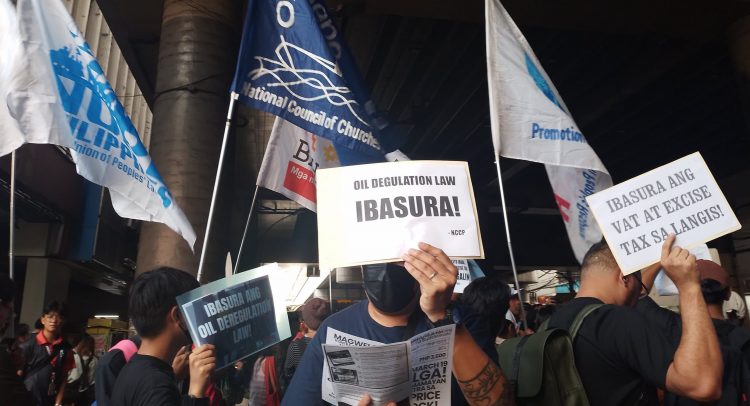
Our historical bias towards the dignity of life and the plight of the poor compels us, the National Council of Churches in the Philippines, to call for genuine and sincere measures to control prices and minimize the effect of the ongoing conflict between the United States (US)-Israel and Iran in West Asia, and its impacts to our economy.
The onslaught of the instantaneous oil price hikes [1] as consequence of the US-Israel instigated war, have hit the people hard, plunging them to further daily misery in a time of a global and local economic crisis. Prior to the conflict, the public are already ailing and resisting the subsequent and massive price increases of basic and prime commodities while politicians have been exposed on mega-corruption flood-control scandals. Earlier this year, Filipinos are already facing the highest unemployment rate since the pandemic at 5.8% or nearly three million Filipinos in January 2026 as reported by the Philippine Statistics Authority. [2]
The Pres. Ferdinand Marcos Jr. administration’s measures, such as the Php 6,000 transport subsidy, the four-day workweek policy, and the ‘libreng sakay’ program, are merely palliative, if not performative, responses. The meager subsidy amounts are insufficient and may not even last a few days, considering that transport drivers incur fuel costs of around Php 3,600 per day. More than ever, the government must decisively intervene to regulate prices, remove unjust burdens, and ensure that the cost of war and global crisis is not carried by those who have the least.
The high, excessive, and overlapping taxes imposed on the majority of poor Filipino do not serve the common good, instead of providing life-giving and meaningful relief, these excise taxes may have paved the way to deeper inequality and the greater risk of being lost to inefficiency and corruption.
It is deeply appalling that amid ongoing large-scale corruption scandals and the worsening economic impacts of war, taxes on basic necessities like oil remain high, excessive, and redundant. Thus, we strongly urge the government to implement measures to control prices, specifically by permanently removing excise tax and VAT [3] on oil products, and by repealing the Oil Deregulation Law. It is also high time to revisit the contemptuous “pork” funds such as the counter intelligence funds of the Office of the President and the Vice President and the abolition of The National Task Force to End Local Communist Armed Conflict (NTF-ELCAC) and re-channel its fund to basic services.
As a Council of churches, we note that this year’s Lent season unfolds in a time of conflicts and economic shock. We invite our churches to a deeper reflection on this global situation of unpeace, to act with compassion and solidarity to the most affected Filipino sectors and groups – especially our jeepney drivers, workers, and producers – and combine it with acts of justice by calling for an urgent path to de-escalation and accountability. Only through these can we lay the foundations of peace. #
Signed and issued on this day, 26th of March, 2026.
Chairperson
[1] According to the Department of Energy, on March 16, diesel prices may hit more than Php 114 per liter with Php 20.40 – 23.90 per liter this week, while gasoline may reach an additional Php 12.90-P16.60 per liter and kerosene price hike at Php 6.90-8.90 per liter.
[2] https://business.inquirer.net/579180/unemployment-rate-jumps-to-pandemic-era-high-of-5-8
[3] The 12% VAT in the Philippines is the highest in South East Asia
