Dhaka Assertions
Testimonies and Narratives
1. Migrants are human beings first and foremost. The labor and services they are capable of doing and delivering are as precious and dignified as their lives. What they do is intrinsic to who they are. The documents they hold or do not hold do not define their being and their humanity. This is the fundamental assertion of Churches Witnessing With Migrants (CWWM). By giving a primary hearing to the stories and narratives of lives and struggles of people in varied forms of forced migration, including human trafficking, CWWM reiterates its work with and among migrants, refugees, and victims of human trafficking as a conscious engagement with God’s precious people made vulnerable and impoverished by historic, systemic and immediate injustices in society.
2. “My name is Forid. I went to Malaysia in 2007 hoping that I can change the economic situation of my family. I was told I would have a job that would pay $18 per day. Instead, I was trapped into forced labor by the recruitment agency. I became a victim of human trafficking. I was expecting to work in a factory. When I arrived, I was told that I would only earn $6 per day for a 10-hour work in a palm oil plantation. I ended working here for 18 months. I asked to be transferred to another job. I was told that for the sum of $1,800 I could change my visa, so I called my father to send the said amount to me. I paid but did not receive the worker’s visa. I became undocumented instead. They took my passport from me. I was trapped. Every night I slept on concrete floor, without food and without a bed. An organization tried to help. I learned about human rights through nongovernmental organizations (NGOs). But the problem could not be solved. The agency did not care about the NGO’s initiatives. The agency is more powerful. This difficult situation lasted for one year. During this time I found out that my father died. Then three months later, my mother died also. I was not able to go home to bury my parents. I eventually surrendered to the Malaysian authorities and opted to return to Bangladesh on 19 November 2016. There are many others like me. While I was in Malaysia, I helped in organizing 2,000 Bangladeshi migrant workers. I also went undercover to expose the emerging trend of ‘baby-selling’ in Malaysia. Now, through Tenaganita (a Malaysian NGO protecting and promoting the rights of women, migrants and refugees), I am an organizer of migrants and refugees.” (Forid Buhia, Bangladeshi survivor of human trafficking in Malaysia)
3. “I was an Oversees Filipino Worker (OFW) in Singapore from 1983 to1985. Shortly after, I returned to the Philippines and became an organizer of a Basic Christian Community. I also joined Gabriela, a national women’s organization. I went back abroad to work as a domestic helper, this time in Hong Kong for 15 years until 2004. In Hong Kong, I helped in organizing migrants. I helped Filipinos who escaped exploitative working conditions from their employers. I was also exploited when I was working in Hong Kong. I would start working at 5:00 in the morning and finish at 2:00 in the morning of the following day. I tutored my employers’ children and I washed five cars every morning. I also assisted my female employer write her master’s thesis. But I also explained to my employer about my involvement in the advocacy for migrants’ rights. Fortunately, I was allowed to leave the house during lunch when the children are in school. I would meet many Filipinos in the market where I did organizing work among them. I would also visit domestic workers in their places of work. In Hong Kong, we started our organizing around the issue of forced remittances. There were 36,000 OFWs deployed per year when the Philippines’ Labor Export Program started 40 years ago. It ballooned to one million per year under President Gloria Macapagal-Arroyo. It peaked to an average of two million Filipinos per year under President Benigno Aquino, III. This is an average of 6,000 per day. The situation in the Philippines is getting worse. And even more so for migrants. Migrant labor is exploited. Their remittances are used to pay for the country’s foreign debt. We are propping up the Philippine economy. Majority of migrants are from peasant and farmer families. This is why Migrante International joined the call for genuine land reform in the Philippines. If implemented, overseas employment can increasingly become an option, not a necessity. We are also calling for an end to all forms of contractualization and provide secure and decent jobs in the country. I am now based in the Visayas, in Central Philippines with Migrante International, organizing migrants at the grassroots. I work in consultation with churches to influence government at local and national levels.” (Connie Bragas-Regalado, Migrante International, Philippines)
4. “I am from Colombia but I am now living in Argentina. I work at the Latin America and Caribbean office of the World Student Christian Federation (WSCF). I am in charge of communication in the region. Unlike other migrants, I did not migrate because of economic situation, war, or climate change, but for education. Because of neoliberal policies in my home country, education has become too expensive. Most young people my age could not afford it. I went to Argentina to study, where schooling is less expensive. I am taking up Social Communication. Like me, thousands of young people from all over Latin America are migrating to Argentina to study. While studying, I also work to augment my allowance for my daily needs. Why do I and my fellow young people need to leave our countries and families just to have an education? My country and the rest of the region does not protect education as a human right. Immigrant students often face discrimination. They are accused of receiving the benefits reserved to Argentinians, or for taking the jobs of the locals. I ask you to continue working for the right to education for migrants. Everyone has a right to choose where to study, and shouldn’t be buried in debt just to get a degree from a university. Leaving the country [and encountering other peoples and cultures] has changed me, and will change you. You will no longer go back as the same person.” (Maria Ulloa Bonilla, WSCF Latin America, Colombian living in Argentina)
A New Geopolitical Context
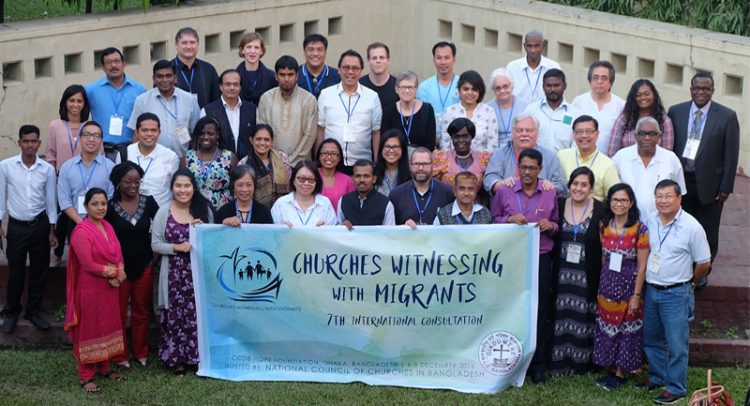
5. CWWM met in Dhaka at a time when our world of international politics with its geopolitical underpinnings, remains not only a formidable challenge, but also one that continues to be re-articulated in forms yet to be more fully understood. One of the hallmarks of today’s new geopolitics is that it has come to be more explicitly experienced by many as being more unapologetically predatory, even more pervasive, and undeniably xenophobic. Ours is not a wholesale critique of geopolitics or dismissal of the present system of states, however. We acknowledge similar concerns, not to mention shared times and places of struggle. But we also want to be clear: from New York to Dhaka and in between, CWWM’s consistent protest and unequivocal resistance have been directed primarily and fundamentally to the way human beings have been subordinated to the racialized, gendered, sexualized, securitized, exclusionary, and unsustainable imperatives that dominate our state-centric system of world order.
6. In fact, the new geopolitics of the present system of states has been marked by forms of political, economic, and cultural life that have consistently undermined any initiatives emanating from both state and civil society that aspire to “acts of mercy and acts of justice.” Forced migration, climate change, economic expansionism, war, human trafficking in all its forms, and technological creep continue mark the landscapes of the world in which we live. All of these profoundly and fundamentally shape and re-shape actual human bodies and the body politic.
Re-asserting CWWM’s Imperatives from New York to Dhaka, and In Between
7. The Dhaka Assertions (2016) are founded on advocacy frameworks, affirmations and agreements that preceded the consultation in Dhaka, Bangladesh on 6 to 8 December 2016. This consultation gathered over 50 participants from 18 countries around the world. As we wrestled with the profound nature of migration-writ-large, we were even more confronted with the complexifying character of forced migration, especially the reality of continuing large scale displacement and dislocation of peoples in many regions of the world. In Dhaka, we reiterated both what we said in our previous consultations, and clarified even more so what it means to advocate for human bodies who are the migrants and refugees, with migrants and refugees themselves. This includes the acknowledgment that geopolitics remains dominant yet inadequate to explain both a human tragedy that is as well a systemic and structural dilemma.
8. New York (2013): We re-assert that migrants and refugees are human beings with human dignity and human rights. They are not commodities that are tradeable like goods and services. Migrants are truly the ones who speak best about their hopes and aspirations and about how to advance and protect their rights and interests. We must prosper the critical principle of representation by and leadership of migrants and migrant organizations at all levels of policy engagement and decision-making that are about them and affect them. Freedom of movement is a protected human right for all. Forced migration, including human trafficking and becoming refugees, subverts and violates this right. Addressing forced migration at home, more precisely at countries of origin—is the way to address its root causes which are deeply embedded not only in the endemic impoverization of peoples under conditions of historic injustices brought about by slavery, colonialism and racism, but also by uneven development of economies brought about by neocolonial relations, and exacerbated by rapid globalization. Simply managing migration is inadequate. CWWM advocates for the well-being, safety and sustainability of migrants as much as fights for social justice and equity in society where all human rights are migrant rights.
9. Stockholm (2014): We re-assert that development justice is the general framework of CWWM’s advocacy work. Its pillars, which are co-constitutive and indivisible, include redistributive justice, economic justice, social justice, environmental justice and accountability to the people. We work on these pillars knowing that forced migration is deeply racialized, gendered, sexualized and securitized, and exacerbated by neoliberal globalization that feeds on structural imbalances within and between countries and regions. Forced migration thrives on the commodification of bodies and the commoditization of their labor and services. Our advocacies intertwine migration, human rights and development justice. Acts of mercy and acts of justice are twin expressions of our work of hospitality, solidarity and advocacy.
10. Istanbul (2015): We re-assert that the pain and tragedy of massive movement and large-scale displacement, dispersal, and dislocation continued to stare us in the face. They posed challenges and invoked responsibilities that are common—working together as peoples of one planet, beyond our national allegiances, in platforms that are transnational and transborder knowing that forced migration cuts across borders and populations. Istanbul reinforced our assertion that we must work on both public policy formulation and legislation as well as the welfare, security and human rights of migrants through their direct engagement as the deciders of their own destinies. The charge from Istanbul is to develop strategies, mechanisms and protocols on how to respond to urgent life and death situations facing migrants, their families and communities while being strategic at addressing systemic and structural inequalities and injustices which are at the root of forced migration.
Dhaka: Claiming Migrant Narratives, Deploying them with Power
11. In Dhaka, CWWM re-asserted its long-held conviction—articulated from New York to Istanbul—that only by focusing on the actual bodies, narratives, and experiences of its tripartite constituencies can the anomalous reality of forced migration be adequately addressed. By metaphorically though no less concretely and strategically focusing on actual bodies, CWWM can supplement the initiatives of other global actors that address, in particular, the objectification, reification, and commodification of human beings and nature arising out of the estrangement intrinsic to the dynamics of capitalism’s relations of production, reproduction, extraction, and representation, and which is legitimized by geopolitical construals of these marketized relations dominant in international politics. Life today—and therefore, politics—cannot be extricated from its multi-stranded embodiments or from multiple bodies across time, space, and place.
12. Migrants and their Testimonies: In Dhaka, as was in New York, Stockholm, Istanbul and in many other places we encountered each other, we celebrated many forms of solidarious acts of accompaniment, empowerment and capacity building that our network, singly or collectively, gave evidence to or have seen in other communities of faith and struggle. It is in Dhaka, however, that we affirmed and celebrated the migrant workers, refugees, and survivors of human trafficking and the power of their stories not only in showing their humanity and their agency to struggle and hope, but also how these stories contribute to a fuller understanding and articulation of public policies and actions to address the conditions that turn human beings into migrants, refugees and victims of human trafficking. In Dhaka, we asserted that these stories are powerful and critical narratives in addressing and countering the historic injustices and psychosocial traumas that inhere with forced migration, in the many forms this takes in the dispersal, displacement, and dislocation of human beings and their communities. In Dhaka, we realized even more how migration is a complex and cross-cutting issue, involving civil, political, economic, social, cultural, environmental, and legal, gender, and many other dimensions. These dimensions require careful consideration by as many actors—people and institutions—advocating for the welfare and protection of migrants and refugees, and addressing their calls for equity and social and development justice.
13. Migration and Labor: One of the dimensions highlighted in Dhaka is the relation of migration and labor. We asserted that migration includes both work and human rights dimensions, saying that the defense of the human rights of workers necessarily includes the defense of the human rights of migrants. Such defense requires advocacy actions and sound solutions to protect the human rights of migrants, including their right to decent work, productive employment, and to living wage. Such advocacy must include the rights of all workers, including migrant workers, to social protections like safety nets which includes healthcare and safe working conditions. It must also include the ability of all workers to promote social dialogue, which is the ability to exercise workplace democracy through which workers participate directly in bettering their conditions locally and in the development of normative policies that improve their lives and livelihoods. Unfortunately, these solutions are slow to emerge despite existing national and international legal instruments which remain to be ratified or implemented, or to sufficiently garner ratifications as to be meaningful, like the UN Convention on the Rights of Migrant Workers and Members of Their Families. This lack of sustainable and concerted solutions concerning migration, especially forced migration, deserves serious study. The role of organized labor—through trade unions—is crucial in this endeavor. Trade unions cannot afford to be indifferent to the plight of migrant workers in their midst. They have a historic role to defend each other in the human rights, justice and equality causes that they share.
14. Human Trafficking in All its Forms: Among the many horrible proofs of the human capacity to be so cruel and degrading to human beings is human trafficking in all its forms. The realities of human trafficking challenged the Dhaka consultation by both the harrowing tales of inhumanity that were told and the compelling reasons why this most urgent, shameful and ignominious practice must be stopped. The entanglements of human trafficking with migration must be unraveled. Human trafficking as a form of forced migration, indeed as a modern-day form of slavery, must be eradicated. This 32 billion US dollar industry thrives by enslaving nearly 20 million people in over 153 countries around the world. A great majority (49%) of victims are females and 26% are children. The victims are trafficked in many forms–for sexual exploitation, as workers in hazardous industries, as drug mules, for forced labour, begging and in the harvesting and selling of human organs. Participants from Bangladesh, India, Malaysia, Uganda, Cambodia, Indonesia, Philippines, and USA, told powerful stories of trafficking, rescue, rehabilitation and prevention through community education, including how they have helped address some deep moral and spiritual questions that arise from the harrowing experience of being trafficked. Such questions included these: What happens to someone’s soul who sells a child for money knowing how the child is going to be abused? To what extent conditions of brokenness and abuse influence one’s capacity to violate the basic human rights of another human being? Why some lives are not considered worthy and important at all? How do we help people in vulnerable situations to develop a heathy self-esteem and self-worth to keep themselves away from the traps of traffickers? How do we enable churches, especially in places which are prone to trafficking, recognize the seriousness of the challenge and help them to act together and decisively? Besides these, an extensive theological reflection on the geo-politics of human trafficking and on the trauma of human trafficking victims resulted in three specific action points. These were: a) A process of communication that facilitates information and enables mutual learning of strategies and methodologies, b) Work towards a Churches’ campaign against human trafficking, and c). Advocate and lobby for effective legislation that addresses human trafficking in all its forms, and protects victims with urgent dispatch.
15. Psychosocial Challenges: Dhaka gave a focused attention to psychosocial challenges that arise due to forced migration. The presentations and exchanges in Dhaka provided impetus for a larger examination among a variety of disciplines, not least of which is the intertwined tasks of the fields of psychology and psychiatry and that of politics and sociology, in understanding both the traumas from historic injustices and the traumas arising from the contemporary experience of forced migration and its entanglements with wars, including resource wars, and conflicts, including economic and political conflicts today. Addressing psychosocial needs will include addressing suffering and tragedy so that migrants and refugees not only develop resilience and capacity to rebuild broken lives and communities, but to also rise and rebuild better, and more sustainably. Many times over, we have been confronted with overwhelming suffering and grief brought about by intertwining circumstances that make forced migration tragic and horrific. The horrendous accounts of human trafficking that we heard in Dhaka, informed us of the crucial intersections of criminal justice, restorative justice, and personal justice in the handling of the manifold and abhorrent practices in which many are ensnared in this modern-day form of slavery.
Berlin Beckons: Invitations
16. Dhaka concluded with the invitation to heighten and deepen CWWM network’s organizational unity, collectively insisting to engage and challenge internally the multiple constituencies that the network members are a part of. Through collective reflection, Dhaka realized how denominational, ecumenical, and multifaith institutions serving migrants and refugees could utterly miss the important task of twinning mercy and compassion with justice and equality in addressing the plight of migrants and refugees. Or how these same bodies, including non-governmental organizations, could eschew or neglect the critical agenda of addressing economic and development imbalances among countries for which reason there is economic displacement and dislocation taking in many ways and means the forms of forced migration. Still another is how addressing the important agenda of criminal justice reform that includes immigration reform must necessarily address the root causes ingrained in a global system and structure of greed and exploitation. In a globalized and massive movement of populations, the situation could be so overwhelming as to not see clearly when racism, discrimination, and xenophobia sway both the discourse and practice of nations and peoples as to ignore them.
17. We may not all be migrants, but we are all human beings laying claim to the same human rights that are equally the rights of migrants. The safeguards and protections we afford to refugees, migrants and displaced peoples speak to that common dignity in humanity that human rights are founded on. And so we adjourned Dhaka with the united resolve to claim this shared responsibility so that we can triumph together over the scourge of forced migration and human trafficking. To be effective, CWWM must take seriously its interlocutory role with governmental and inter-governmental bodies, especially multilateral agencies whose purposes affect and impact the human rights and welfare of migrants and refugees. Dhaka asserted the critical importance of developing and implementing a set of human rights-based and pro-migrant agreements on all levels. Multilateral negotiations are instances where we must ensure these agreements.
18. We must pay special attention to the elaboration and development of two global compacts—one for the “safe, orderly and regular migration” and another for refugees. The responsibility to produce these global compacts lies largely with governments who agreed to do so at the United Nations High Level Meeting on addressing large movement of refugees and migrants that met in New York on 19 September 2016. We must help ascertain that whatever is produced in 2018 by way of global compacts will secure for migrants and refugees access to human rights and their protection, and that mechanisms to reduce, if not eliminate, their vulnerabilities are in place. These global compacts must prove that migrants and refugees, indeed no one, will be left behind. We say this knowing that refugees and migrants are people who are increasingly left behind, by borders being closed and walls being erected, either by enforcing official policy or by blatant display of discrimination and bigotry. Non-governmental organizations play a critical role in reminding governments and the United Nations of the critical juncture between migration and development, especially the successful implementation of Agenda 2030, through the Sustainable Development Goals, in particular Goal 10.7. We say this to alert ourselves never to reduce migration to a management issue and to instrumentalize it for development, if this were to mean exploiting it so as to profit from it.
19. Many more issues and agendas remain equally crucial as those we have addressed above. We name them here to memorialize ourselves of their urgency. These issues include extractivism, increasingly understood as referring to an economic model centered on the large-scale extraction of human and natural resources for the purposes of selling them in the world market as raw materials, with little or no processing. The effect of extractivism on agricultural economies that rely on the land for production is grave, and so are its effects on indigenous peoples. Dhaka challenged CWWM into looking at how the predatory practices that come with extractivism can be compounding, if not causing, forced migration. Another issue of urgency is climate-induced movement of peoples. This phenomenon has spawned the term “climate refugees”—people who were most vulnerable and therefore forced to move and relocate due to either one or a combination of sea-level rise, extreme weather events, and drought and water scarcity. Still another issue that beckons urgency is a more focused look at the gendered and sexualized nature of migration. For example, looking more closely at the increasing number of women and girls in forced migration, especially among those in situations of trafficking. This phenomenon is sometimes referred to as the feminization of migration. Another related issue deserving its own discussion is the situation of LGBTQIs in the forced migration chain.
20. And so Berlin beckons, occasioned by the hosting of the government of Germany of the 2017 Global Forum on Migration and Development and the invitation from our CWWM partners in Germany, especially Brot für die Welt (Bread for the World). CWWM convenes in Berlin with the responsibility to address the many issues that Dhaka commended to CWWM. We go to Berlin even more acutely cognizant of the need to prosper common global public goods such as human dignity and human rights, ensuring that these continue to be the central undergirding principles of agreements like the two global compacts that are on the multilateral drawing board. We must go to Berlin to help promote and honor the timeless humanitarian principles of humanity, neutrality, impartiality and independence, ensuring that these remain equally intact and centrally enshrined in any agreements to be negotiated, knowing full well that while they are enshrined in international humanitarian laws, they are often known in their breach than in their implementations especially in situations affecting forced migrants and refugees. We go to Berlin carrying CWWM’s foundational framework—asserting them as summons to commit to mobilizing our constituencies and resources, including their faith resources, and their goodwill, in addressing the pressing needs of all migrants, refugees and trafficked persons.
21. “The crisis of forced migration continues to deepen poverty, unemployment, and displacement, thereby causing unbearable consequences. This reality diminishes our dreams to settle in our home countries and enjoy sustainable employment with respect and dignity. While abroad, we face threats and attacks. Everyone is in danger now. Our rights are eroded. Our future is bleak.” (Eni Lestari, Chairperson of International Migrants Alliance (IMA), Indonesian working in Hong Kong)
22. Berlin beckons even as human beings like Forid, Connie, Maria, and Eni invite us to live out the full meaning of “acts of mercy and acts of justice.”
CWWM7
Dhaka, Bangladesh
6-8 December 2016
Dowload in PDF: Dhaka Assertions
