
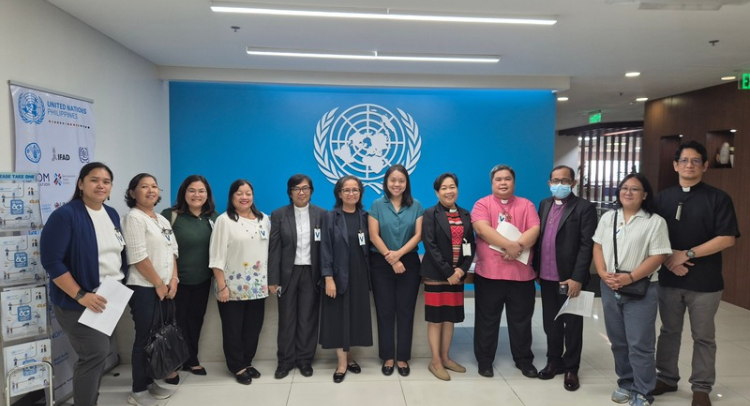
MANDALUYONG CITY—The National Council of Churches in the Philippines (NCCP) along with the health sector called on the United Nations Special Rapporteur on the promotion and protection of human rights and fundamental freedoms while countering terrorism, Mr. Ben Saul, on his academic visit to the Philippines, on September 10, 2026.
In a briefer submitted to the Special Rapporteur, the NCCP raised concerns over the use of the Anti-Terrorism Act (ATA), the Terrorism Financing Prevention and Suppression Act, and related government measures against individuals and organizations engaged in lawful religious, humanitarian, pastoral, development, and human rights work.
The individuals and organizations cited by the NCCP work primarily among poor, marginalized, Indigenous, and conflict-affected communities. According to Bishop Joseph Agpaoa, the NCCP Vice Chairperson and head of delegation, “Churches and church-related organizations frequently provide humanitarian and essential services in remote and historically underserved areas, including communities affected by armed conflict and military operations.” He further stressed that such work is an expression of religious faith and a commitment to uphold the inherent dignity and rights of every person.”
Cases previously raised with the UN
The NCCP provided updates on several cases previously brought to the attention of the UN Special Procedures through communications issued on October 10, 2023, by Mr. Saul’s predecessor and five other UN mandate holders.
The NCCP also submitted information on several more recent cases involving church workers, volunteers, and human rights defenders, and submitted a number of cases involving church workers and human rights defenders facing detention, terrorist-financing allegations, and serious criminal charges:
- Aldeem Yañez, a deacon from the Iglesia Filipina Independiente member and political prisoner, remains detained on non-bailable charges, including 55 counts under the Anti-Financing of Terrorism Law. He was ordained an IFI deacon while in detention in April 2025.
- United Methodist pastors Julius Neri Camannong and Joel Ordaneza, along with driver Romeo Russel, face a terrorist-financing complaint after providing sanctuary to two people who said their lives were in danger. They deny wrongdoing and filed counter-affidavits in January 2025.
- Anne Marie Pascual, NCCP’s Program Officer for Advocacy and Networking for Human Rights of the NCCP, was among 11 rights defenders accused of giving supply of rice and other vittles to the New People’s Army in Cagayan in 2019. The allegations stemmed from an incident involving rice that had been buried and was later excavated in the hinterlands of Cagayan Valley seven years after. Two military assets reportedly provided information that led authorities to the location where the rice had been buried.
Call for renewed peace negotiations
The NCCP further called on the UN Special Rapporteur to urge the Philippine government to create an enabling and rights-respecting environment for the resumption of formal and meaningful peace negotiations with the National Democratic Front of the Philippines (NDFP).
“Counter-terrorism measures must never become instruments for criminalizing the legitimate exercise of religious freedom, humanitarian action, human rights advocacy, or engagement with marginalized and conflict-affected communities,” Bishop Agpaoa said.
From left to right: Ms. Keidy Mendiola of the Free Doc Ana, Free Marc Campaign; Ms. Teresa Diata of the Rural Missionaries of the Philippines; Ms. Anne Marie Pascual of the NCCP; Dr. Edelina Dela Paz of the Health Alliance for Democracy, Health Action for Human Rights; Rev. Irma Balaba of the United Church of Christ in the Philippines; Ms. Ruperta Enriquez of the NCCP; Ms. Kat Berza of the Council for Health and Development; Rev. Glofie Baluntong of the United Methodist Church; Bishop Dindo Ranojo of the Iglesia Filipina Independiente; Bishop Joseph Agpaoa of the United Church of Christ in the Philippines; Ms. Johanna dela Cruz of the NCCP; and Fr. Eduardo Ruazol of the Iglesia Filipina Independiente. Photo by NCCP.
The Council warned that the invocation of counter-terrorism measures against church workers and organizations risks criminalizing protected fundamental freedoms and creating a profound chilling effect on humanitarian and faith-based work among vulnerable communities.
“The protection of human rights and fundamental freedoms must remain central to all counter-terrorism efforts,” Bishop Joseph Agpaoa added. “Churches and faith-based organizations must be able to carry out their ministries and humanitarian work without fear of reprisal, criminalization, or persecution,” he further averred.
The NCCP reiterated its commitment to accompanying the poor, marginalized, Indigenous peoples, and conflict-affected communities and to promoting human rights, peace, justice, and the dignity of every person. #
