
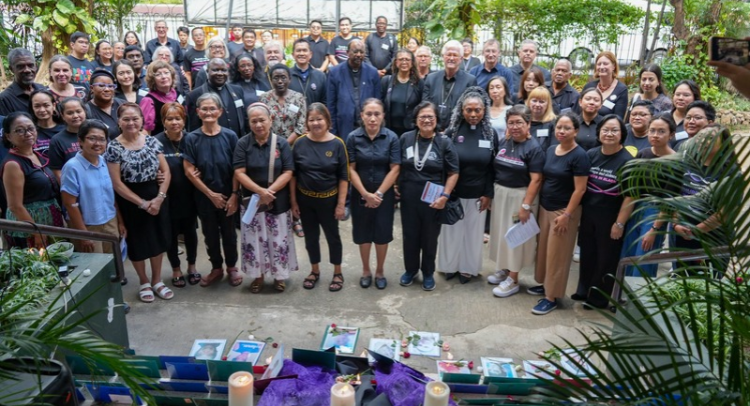
Women from Rise Up for Life and for Rights — an organization of victim-advocate relatives of people killed by the Duterte administration’s “drug war” — shared with leaders of the World Council of Churches (WCC) truths of loved ones extrajudicially killed by police and unknown gunmen. The dialogue was organized by the National Council of Churches in the Philippines (NCCP) as part of Thursdays in Black, a WCC campaign to end violence against women.
“I was on my way to market and saw my son crying. I gave him a piece of candy, then I left. But when I got home, my son had been killed,” said Emily Soriano.
Normita Lopez said of her son, “He was seen on the railroad, raising his two hands, surrendering to the police, saying ‘Don’t shoot.’ But the policeman pushed him down and shot him four times in his body and once in his right hand.”
The families also spoke about their struggles in seeking justice. “No one really cared or listened to us, but I would like to thank the WCC, which facilitated my travel so I was able to bring our stories to the United Nations,” said Jane Lee.
“I didn’t know how to get justice, so I joined Rise Up because I believe that if one of us gets justice, it is also justice for my son,” said Estrella Nonay.
Responding to the question of how the church is present in the context of the killings, Deaconess Norma Dollaga of Rise Up said, “Another mother told me: ‘Since my son was killed, I had planned to go to church to pray and ask God why my son was killed.’ God did not answer her with lightning and thunder; rather, God was with her, weeping and crying, perhaps also asking why such killings happen. God did not answer the mother directly. Instead, the ‘we’ of the church came to the mother.”
“We are sharing with you sacred stories. Now that you have heard them, you are witnesses. We invite the WCC to stand in solidarity with the families of the victims in their quest for justice.” said Deaconess Dollaga. “Duterte has been declared fit for trial, and we, the victims and advocates and lawyers, are fit for trial!”
“No human being deserves to be treated in the ways you have described your loved ones having been treated,” said WCC Vice-Moderator, Rev. Merlyn Hyde Riley. “The challenges we face together are deep-seated challenges. This is not just about drugs, but there are deep-seated issues — structural, political, economic, social, and spiritual.
“We recommit ourselves as members of the WCC to continue to work alongside you here in the Philippines and across the world in seeking to address these structural issues that diminish human dignity and cause so much pain, so much suffering, and yet so much courage.”
WCC General Secretary Rev. Prof. Dr. Jerry Pillay emphasized meeting the Rise Up mothers so soon before Duterte’s trial in The Hague on November 30. “We will find ways to accompany you. On November 24th, we will be co-partners with NCCP on an ecumenical just peace program (the Global Ecumenical Forum for JustPeace in the Philippines, GEF-PH). Together, we will find ways to work with you and work with them to address some of the realities you’ve laid out for us.”
“These stories should be uplifted as a model for how a society can mobilize and bring powerful people to accountability.” said WCC Programme Director for Unity, Mission and Ecumenical Formation, Rev. Dr. Kuzipa Nalwamba, “The weight of grief is palpable, but there is some reprieve in something actually being done.”
“How can the church beyond the Philippines continue to be in solidarity with the mothers but also in calling for justice?” said Rev. Dr. Karen Georgia Thompson, General Minister and President of the United Church of Christ and President of the World Communion of Reformed Churches, noting that global justice and solidarity would be examined and scrutinized at the GEF-PH launch. “How do you stop this from happening again? Poor communities, marginalized communities bear the brunt of programs that are designed to harm. And the church needs to continue to be a prophetic witness.”
Dr. Thompson drew parallels between anti-Black, anti-immigrant, and anti-poor state violence in the United States. “It’s the same system at work targeting people, getting rid of people that the system has identified as being less than. Whether it’s from xenophobia, poverty, or drug use — we need to speak about human rights and dignity, respect of all people, and the fact that we are made in God’s image and that none of us should be targeted.”
The WCC is in Manila from 18 to 24 November for their twice-yearly Executive Committee meeting, hosted by the NCCP.
