
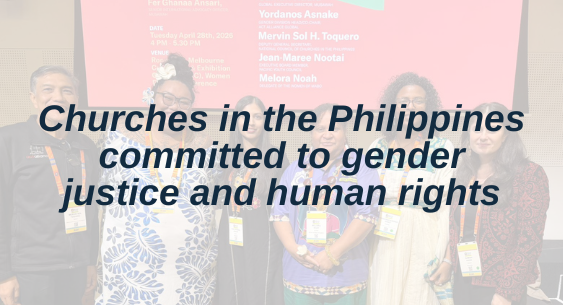
MELBOURNE, AUSTRALIA—Mr. Mervin Sol Toquero, NCCP Deputy General Secretary, reported on the situation of Filipino women and the ongoing efforts of churches and civil society organizations to address state-perpetuated gender-based violence, human rights violations, and the systemic injustices preventing women from realizing life in all its fullness during the Women Deliver Conference 2026.
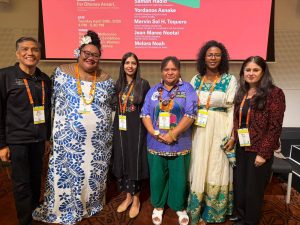
The Women Deliver Conference 2026 is a global gathering of advocates, experts, and leaders dedicated to advancing gender equality. Anchored by the theme “Change calls us here,” participants engaged in various concurrent forums to reimagine how to resist systems of inequality and rebuild a world where women and girls can reach their full potential. Mr. Toquero spoke at a side event on April 28, 2026, titled, “Mobilizing support for gender equality across religious and cultural contexts”—a conversation co-organized by Musawah, Act Church of Sweden, and ACT Alliance.
Below is the transcript of his report for the Women Deliver Conference 2026:
Systemic poverty, rampant inequality, endemic corruption and pervasive culture of impunity prevent women in the Philippines from fully enjoying sexual and reproductive health and rights[1]. Wages are insufficient to meet daily needs for this vast majority[2], and the gender wage gap is prevalent[3]. Health expenses are high[4] and access is uneven[5], compelling poor women to prioritize putting food on the table rather than other concerns[6].
The government of Pres. Marcos Jr., partly to assuage public anger on issues of corruption, increased the 2026 health budget, but it still falls far short of WHO standards[7]
Teenage pregnancy is high, second-ranked in Southeast Asia[8]. The Philippines, a predominantly Christian nation with a Roman Catholic majority, has a prevailing conservatism on public discourses and education on sexuality. Certain religious groups are also preventing the passage of a law that outlines a national policy for teenage pregnancy prevention[9].
A prevailing culture of impunity due to years of rampant human rights abuses have resulted in 13,211 cases of gender-based violence (GBV) in 2025 — about 36 women per day.[10] State-perpetrated gender-based abuses committed by men-in-uniform are significant[11]. They cover domestic violence, custodial rape or abuse during operations or militarization.
This systemic violence prevents the majority of women to make informed and self-determined choices regarding their SRHR (sexual and reproductive health and rights) in particular and gender justice in general.
But gender and human rights advocacy remain active and dynamic. CSOs, women’s organizations, and other grassroots movements continue to advocate for human rights including rights-based reforms for women. They have exposed corruption, called for increased public funds and lobbied for passage of reform laws. But these efforts are amid shrinking civic space, where activists are subjected to harassment, red-tagging, and state repression. Their work is more dangerous, but this underscores the urgency of defending democratic space and protecting people at the forefront of the struggle for gender justice and human rights in general.
Read more: Reflections from Women Deliver 2026 – Melbourne
Read more: Filipino voices represented at Women Deliver Conference 2026As a faith actor, I and my organization, the NCCP, count ourselves in solidarity with this movement for change. For gender justice and human rights, the NCCP:
- facilitates discussions among churches on various gender justice issues including gender diversity;
- provides psychosocial, legal and other direct services to GBV survivors;
- conducts gender justice and peer counseling trainings to first responders;
- lobbies for passage of laws;
- organizes jail visitations and provide services to women political prisoners; and,
- uses our prophetic voice in public spaces and helps bring the cases of HRVs of women HR defenders to various governments and the UN.
We find inspiration in Jesus Christ who embraced humanity and lived and preached among the poor, especially among people in in the margins. As Christians, we will work and pray for the transformation not only of Philippine society, but of other societies, so that the reign of God’s peace with justice, including gender justice, becomes a reality[12]. #
REFERENCES
[1] Poverty is prevalent in the Philippines, with 51% of Filipinos or 14.3 million families rating themselves as poor. https://newsinfo.inquirer.net/2165996/51-of-filipino-families-still-consider-themselves-poor-sws
[2] In the National Capital Region alone, daily minimum wage is at PHP 695 (USD 11.00) but the daily family living wage for a family of five to live with dignity is PHP 1,266 (USD 20). www.Ibon.org
[3] With out-of-pocket spending accounting for 42.7 percent of total health expenditures. Ulat Lila 2026 – Sa Ilalim ng Krisis at Korupsyon: Kababaihan Bumabangon at Lumalaban, Center for Women’s Resources, March 2026
[4] This is above the average in Asia which is 66 (https://psa.gov.ph/content/government-shares-447-percent-countrys-health-spending-2024-primary-health-care-expenditure). https://www.pchrd.dost.gov.ph/news_and_updates/uhc-goals-aim-to-address-inequities-in-maternal-and-child-health-former-doh-secretary-romualdez/
[5] Access to health services is also highly uneven with urban centers having relatively better services, while rural areas suffer severe shortages of health facilities, medicines, and trained health workers. These reinforce existing inequalities. Maternal mortality ratio is high at 84 women dying per 100,000 live births, which is above the average in Asia which is 66 https://genderdata.worldbank.org/en/economies/philippines#). Over 100 poor women die during childbirth for every 1,000 pregnancies, while among the rich, the figure is less than 10. https://www.pchrd.dost.gov.ph/news_and_updates/uhc-goals-aim-to-address-inequities-in-maternal-and-child-health-former-doh-secretary-romualdez/ .)
[6] The government of Pres. Marcos Jr., in part to assuage public anger on issues of corruption, increased the budget for health this year with ?448.125 billion. However, this amount is only 1.45% of the Gross Domestic Product (GDP), way smaller from the 5% World Health Organization (WHO) standard (Ulat Lila 2026 – Sa Ilalim ng Krisis at Korupsyon: Kababaihan Bumabangon at Lumalaban, Center for Women’s Resources, March 2026)
[7] The budget for 2026 is ?448.125 billion (USD 7.38 billion). This amount is only 1.45% of the Gross Domestic Product (GDP), way smaller from the 5% World Health Organization (WHO) standard.
[8] Over 500 girls aged 15 to 19 become mothers each day. The number of girls under 15 getting pregnant are also increasing. https://www.humanium.org/en/the-current-teenage-pregnancy-crisis-in-the-philippines/
[9] Senate Bill No. 1979, the Adolescent Pregnancy Prevention Bill, seeks to institutionalize Comprehensive Sexual Education (CSE) and allow minors to access reproductive health services without parental consent and promotes age-appropriate, accurate, and culturally sensitive content to help teens make informed decisions. Ibid.
[10] This is about 36 women per day or nearly two women per hour. Cases ranged from domestic violence, rape and acts of lasciviousness. Ulat Lila 2026 – Sa Ilalim ng Krisis at Korupsyon: Kababaihan Bumabangon at Lumalaban, Center for Women’s Resources, March 2026.
[11] According to the Center for Women’s Resources, from 2022 to 2025, there were 40 cases of state-perpetrated VAW such as beatings, rape, molestation, and murder of women and children. Ulat Lila 2026 – Sa Ilalim ng Krisis at Korupsyon: Kababaihan Bumabangon at Lumalaban, Center for Women’s Resources, March 2026.
[12] I find inspiration from the sermon of prominent feminist theologian, Rev. Dr. Lizette G. Tapia-Raquel, Academic Dean of the Union Theological Seminary – Philippines, during the 2026 NCCP Ecumenical Easter Sunrise Service.
