
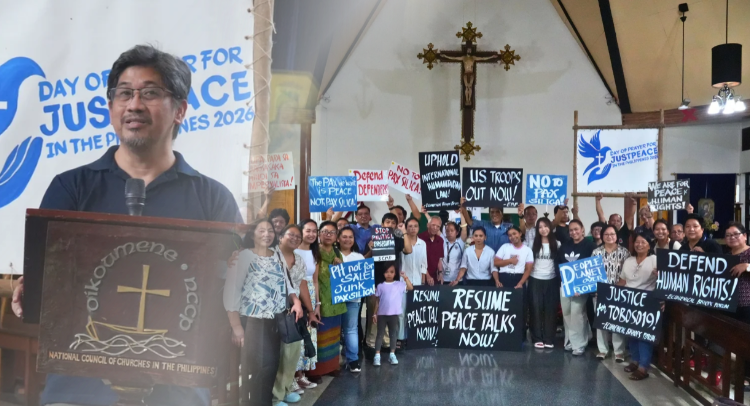
QUEZON CITY—In the absence of meaningful peace negotiations and amid the socio-environmental risks posed by the U.S.-led Pax Silica, the ecumenical community gathered for this year’s Day of Prayer for JustPeace in the Philippines to discern their prophetic witness rooted in God’s compassion and justice for the poor and oppressed.
Bishop Ciriaco Francisco (Ret.) of the United Methodist Church and General Secretary of the Ecumenical Bishops’ Forum (EBF) reiterated that addressing the conditions that enable violence and injustice in communities and the environment is necessary to attain just and lasting peace—citing, in the Philippines’ case, the need for principled peace talks.
He also noted that not all projects labeled as “peace,” like Pax Silica, bring justice, explaining that there is a kind of peace that is imposed to secure the interests of the powerful, silence dissent, and demand the submission of peoples and communities.
AGHAM spokesperson Dr. Giovanni Tapang expounded on this, illustrating how competition for critical minerals, semiconductors, and artificial intelligence threatens the broader oikoumene.
“Whoever controls the silicon chain controls the future economy and the next wars,” Dr. Tapang said, explaining that Pax Silica is the U.S.’s way to preserve its hegemony against its biggest geopolitical and economic rival, China, which currently dominates the tech manufacturing industry, particularly rare earth refining.
Apart from large-scale energy and water use required to process the minerals, one of the major issues regarding Pax Silica is the waste it will leave behind on Philippine soil, specifically leftover waste from processing these rare earths, such as thorium. This naturally occurring radioactive mineral, Dr. Tapang highlighted, needs meticulous waste management, noting that it takes billions of years to decompose.
Another major concern is labor exploitation associated with raw processing, citing the five-decade history of cheap labor and low-value jobs in the electronics industry.
“It is not Pax Silica that will bring us towards development, but genuine land reform and national industrialization,” said Dr. Tapang. “We do not have these because, for the longest time, we have been building industries for warmongering and development of other countries.”
In his challenge of peace, The Most Rev. Nestor Poltic, Sr., Prime Bishop of the Episcopal Church in the Philippines (ECP) and Co-chairperson of EBF, emboldened the congregation to ask a deeper question—apart from picturing the kind of Philippines they want: “What kind of people will we become? Will we accept injustice, or will we work for justice? Will we prepare for war, or will we prepare the way for peace?” His message was read by The Rt. Rev. James B. Boliget, Bishop of the Episcopal Diocese of Central Philippines and Co-chairperson of the EBF-NCR.
Prime Bishop Poltic challenged them to become proclaimers of justice, compassion, and peace; to discern the signs of the times; to stand with people; and to speak the truth with courage. He also emphasized the need to call for transparency, genuine consultation, protection of human rights and creation, and the pursuit of meaningful peace negotiations.
He encouraged them not to grow weary of doing good, reminding them not only to pray and discern but also to transform these into solidarity and action.
The Day of Prayer for JustPeace in the Philippines is an annual observance to demonstrate support for the resumption of negotiations between the Philippine government and the National Democratic Front of the Philippines, anchoring it on the day of the signing of The Hague Joint Declaration in The Netherlands on September 1, 1992.
Read more: Day of Prayer for JustPeace in the Philippines 2026
Read more: Let us Observe the National and International Day of Prayer for Just Peace in the Philippines
This year, church leaders and members from the Apostolic Catholic Church, Episcopal Church in the Philippines, Iglesia Unida Ekyumenikal, Iglesia Filipina Independiente, and United Methodist Church participated alongside basic sectoral groups and peace advocates.
Co-organized by the National Council of Churches in the Philippines, St. Andrew’s Theological Seminary, ECP, EBF, and the Philippine Ecumenical Peace Platform, the event was held on September 1, 2026 at St. Andrew’s Theological Seminary Chapel. #
